
This is a companion to the Biodiversity of Astley Park article click here, both are based on the Wildlife Survey carried out by Friends’ volunteers during 2024. The full published reports of that work can be seen by clicking here
There are three main habitats in the Park – woodland, grassland and aquatic. Each of these habitats supports a range of wildflowers which bloom at different times according to the changing seasons. This article will broadly describe many of the wildflowers found in the Park as they make their colourful appearances through the calendar year.
Some of the wildflowers in the Park occur entirely naturally. Others have been introduced as seeds (such as with the Wildflower Meadow), seedlings (the Woodland Wildflower Project) or bulbs (the Snowdrop Trail) – all initiatives that the Friends of Astley Park have helped enable. This article does not refer to the cultivated ornamental garden areas of the Park.
First off the mark, are Snowdrops (Galanthus nivalis) – top left below – which begin flowering in January. As can be seen on the previously mentioned Snowdrop Trail these plants will thrive in open areas and in woodlands given that the trees in the latter are not then in leaf and shading the ground. Another quite early starter is the Wood Anemone (Amemonoides nemorosa) – bottom left – which grows in wide spreading drifts under the still leafless trees in Great Wood, particularly alongside the main path from Ackhurst Lodge. This area is in places quite boggy but nevertheless in early Spring it also supports the diminutive Lesser Celandine (Ficaria verna) – top right – and the more prominent Wild Garlic or Ramsom (Allium utsinum) – bottom right.

As Spring advances an impressive showing in the Park is made by swathes of Bluebells (Hyacinthoides non-scrita), pictured immediately below. Again, these are present in Great Wood, and also along the northern boundary of the Park at the rear of Millfield Road and Rectory Close. Some of those plants may be nearby garden escapees especially ones that flower pink or white! However, as Spring turns into Summer there are also a few small clumps of similar looking white belled flowering plants that are a quite different species. They are variously called Snowbell or Three-cornered Galic (Allium triquetrum) – so called because of their triangular cross section stems. These are again found on the woodland edge near Rectory Close – see below pictured alongside a clump of Bluebells.


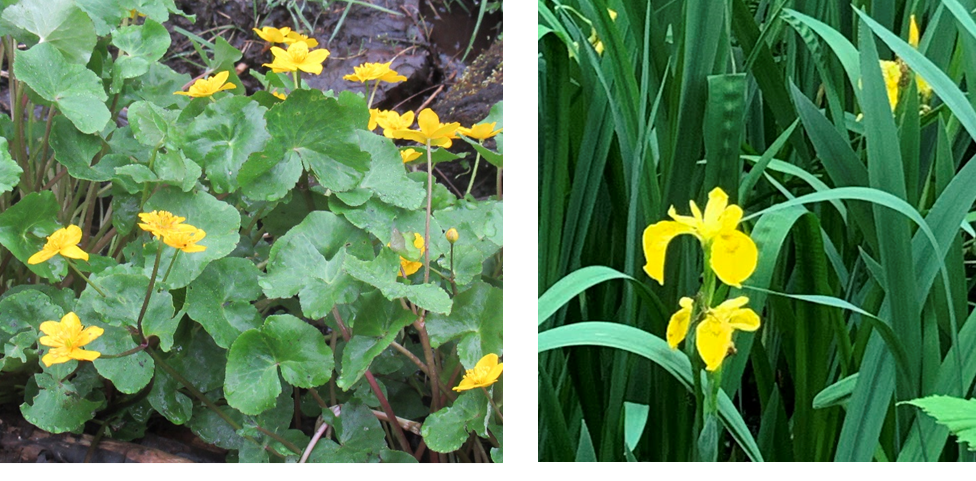
There are three yellow flowering plants in the Park that grow in aquatic or marshy land over the Summer months. Marsh Marigolds (Caltha palustris)- pictured below left – appear in quite small clumps in various boggy/water margin places and appear to tolerate some shade. Flag Irises (Iris pseudaorus) – right – occupy similar locations, there is normally a patch of them just off the main path to Park Road near the Lake dam. The Lake itself has an impressive showing of Water Lilies (genus Nymphaeceae ) each Summer.
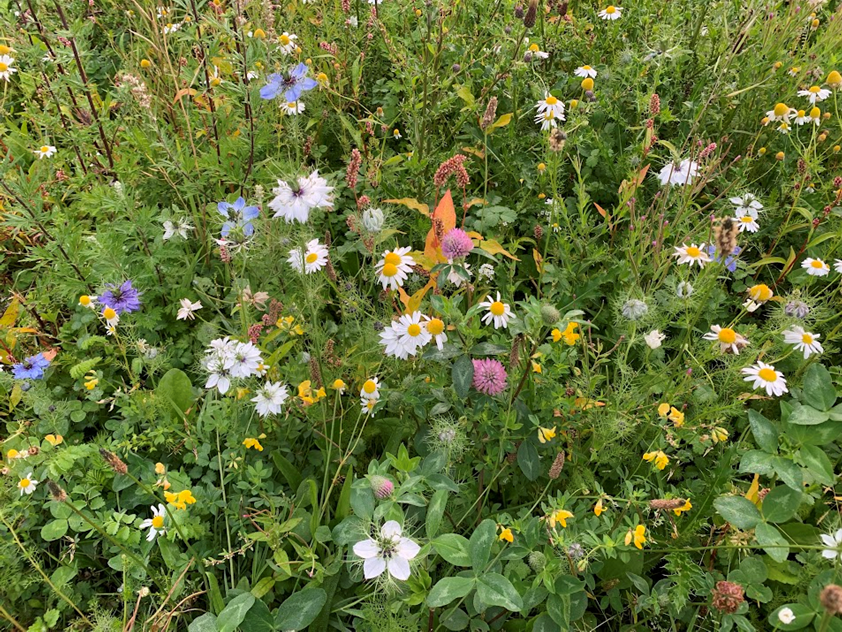
By the middle of the year the Council managed Wildflower Meadow, located across the main path from the Sensory Garden, is making its presence felt. The picture below shows just some of the species present – including the pink coloured Red Clover (Trifolium pratense), blue Love-in-a-Mist (Nigella damascena), white Oxeye Daisy (Leucanthenum vulgare), yellow Greater Bird’s-Foot-Trefoil (Lotus pedunculatus), and the dark red Spotted Lady’s Thumb (Persicaria maculosa).
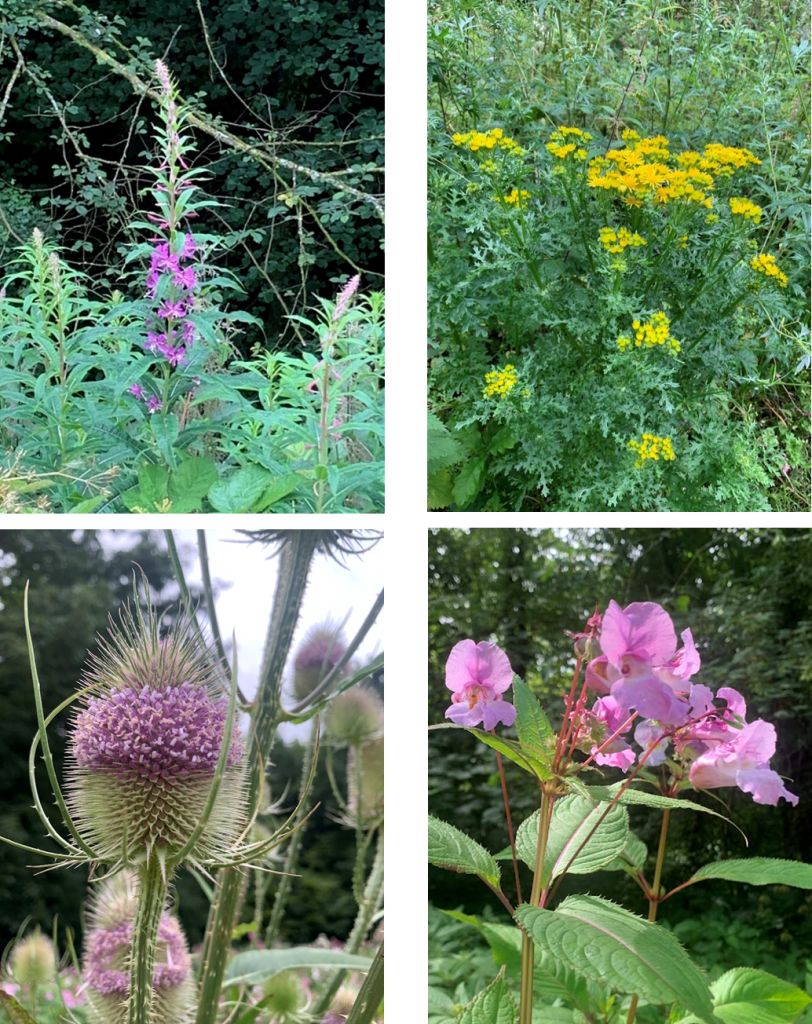
The backdrop to the Wildflower Meadow is a ribbon of unmown land bordering the River Chor. Here a range of wildflower species grow tall – Fireweed (Chamaenarion angustifolium) – top left below, Ragwort (Jacobaea vulgaris) – top right, Wild Teasel (Dipsacus fullonum) – bottom left and sadly Himalayan Balsam (Impatiens glandulifera) – bottom right. The latter is, as the name suggests, a plant alien to Britain that can crowd out native species. It is widespread in the Park and each year Friends’ volunteers, with the help of other groups, uproot as many specimens as possible before their flowers can produce seeds – see Balsam Bashing
The extensive mown grassland in the Park does not get much of a chance to show signs of flowering plants due to the regular cuts it gets. However, when left unmown Dandelion (Taraxacum officinale), Daisy (Bellis perennis), Buttercup (genus Ranunculaceae) and Clover (genus Fabaceae) make their presence known such as pictured below where there are also Campions (italics) on a bankside of the Lake on the opposite side from Astley Hall.

By the time high Summer is here the trees in Great Wood are in full leaf and the commonly occurring Beech (genus Fagus) specimens here cast a particularly dense shade. This does not give the late emerging ground flora much chance to grow. However, where there are gaps in the leaf canopy Enchanter’s Nightshade (Circaea lutetiana) makes an appearance – on the left below. It is an indicator species of an area of Ancient Woodland – a treed area that has existed since at least 1600. A similar woodland plant is the Cuckoo-pint (Arum maculatum) – the one pictured below (right) was spotted near Ackhurst Lodge.

Two far east Asia originating plants that can grow to become tree-sized specimens are the Rhododendron (Rhododendron ferrugineum) pictured below left on the edge of Great Wood and a Magnolia (genus Magnolia) next to the Walled Garden lawn, below right. Rhododendrons were once common in the Park but they are an invasive species and numerous specimens have been removed.

Late Summer flowering plants in the Park include the Dog Rose (Rosa canina) pictured left below and found alongside the rear of Millfield Road path and Common Hogweed (Heracleum sphondylium) below right growing alongside the River Chor bridge near to the Lost Fountain. Although it can grow up to 2 metres high the Common Hogweed should not be confused with the even larger Giant Hogweed (Heracleum mantegazzianum) which is thankfully not present in the Park as it is invasive and poisonous.

And there we have it. A quick trip through the seasonal changes in wildflowers in Astley Park. If you happen to spot and photograph others (there are more), then why not offer to send us your pictures for featuring on our website? Get in touch by using ‘Contact Us’ on our website or email us friendsofastleypark@gmail.com
 Friends of Astley Park