
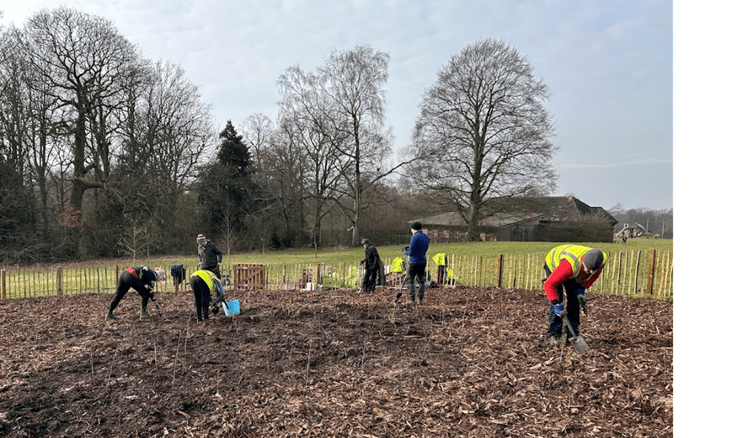
Although this was not a project Friends of Astley Park instigated, our volunteers were very much involved in implementing it. In February 2025 we assisted in the planting of 1,500 whip sized trees into specially prepared ground so they could grow into a typical native species mixed lowland woodland. Officers at Lancashire County Council had the idea of creating at least one micro-woodland in each of the 14 District and Unitary Council areas across the County. The planting method used was first developed in Asia but was then successfully first tried out in Europe around 2015.
The project was funded by grants from the Forestry Commission and the government Department for Environment, Food and Rural Affairs. Chorley Council fully supported a micro-woodland being created in Astley Park. The site in the Park chosen for this being located behind Pet’s Corner where a circular area of approximately 20 metres in diameter was set aside. Protected from trampling by a chestnut paling fence, the soil within was double dug, treated with spent mushroom compost and topped with bark chippings by a contractor. This meant the ground had the high fertility and natural composition that resembled a mature woodland soil.

To further give the saplings a good chance to grow well, their roots were first dipped into a root stimulating compound. They were then planted close together (at 30cm spacings) but randomly distributed so the species would complement one another by growing to various height layers or storeys. This meant there would be very little need for maintenance in future years.
Over 20 different tree species were used including Alder (Alnus glutinosa), Downy Birch (Betula pubescens), Hazel (Corylus avellana), Broom (Cytisus scoparius), Crab Apple (Malus sylvestris), Sessile Oak (Quercus petraea), Grey Willow (Salix cinerea), Rowan (Sorbus aucuparia) and Gorse (Ulex europaeus). The first indication of how well the trees have ‘set’ will come in the summer of 2025 when they should be in full leaf for the first time.
 Friends of Astley Park