Autumn is a good time of year to discover fungi. Some species form quickly during the damp, cooler days. Others, especially those growing more slowly out of decaying wood, have often been present for months if not years but are newly exposed as other nearby vegetation dies back.
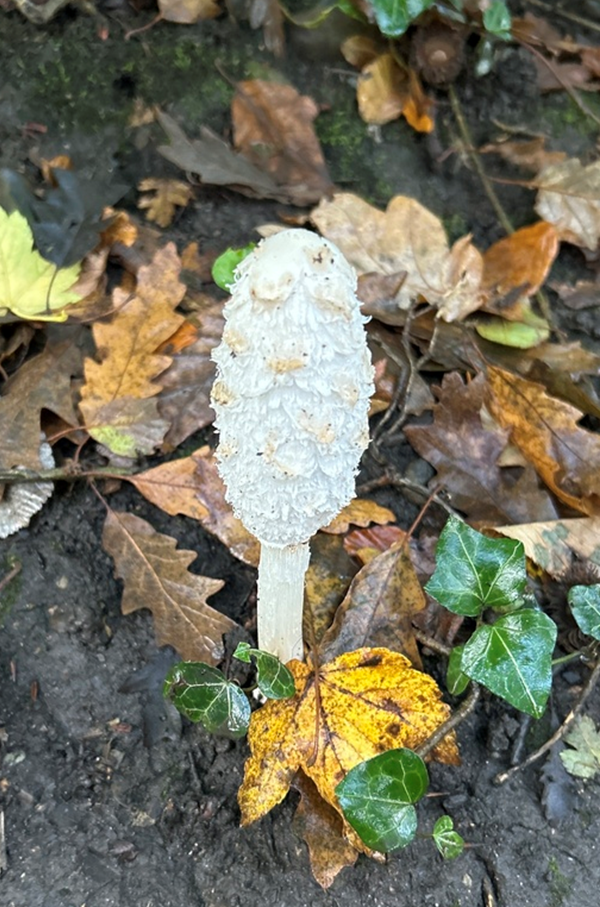
In the former category is Shaggy Mane (Coprinus comatus). The pictured below specimen was discovered next to the main top path in Great Wood. This is a species that is widely distributed across Europe and North America. They can grow up to 20cm tall, the pictured one is about half that height.
Moving to species that anchor themselves to wood the Turkey-tail (Trametes versicolor) fungus picture below is attached to one of the seats at the Lost Fountain. As with many species of fungus there are numerous varieties exhibiting different colours, but most have caps that grow no larger than 8cm.

Coprinellus micaceus commonly known as the Mica Cap pictured below is another commonly found small fungus which forms as up to 3cm diameter mushrooms. They grow in dense clusters – these were found next to the path near Rectory Close.

Perhaps the most odd-looking find is the Jelly Ear (Auricularia auricula-judae) pictured below which is a form of bracket fungus but much smaller than most – the size of a human ear. The Latin name arising from the fact that the ‘ears’ appear mostly on elder – the tree species that Judas hanged himself on after betraying Jesus Christ to his executioners. The picture was taken just off the main path in the Park opposite the playgrounds.

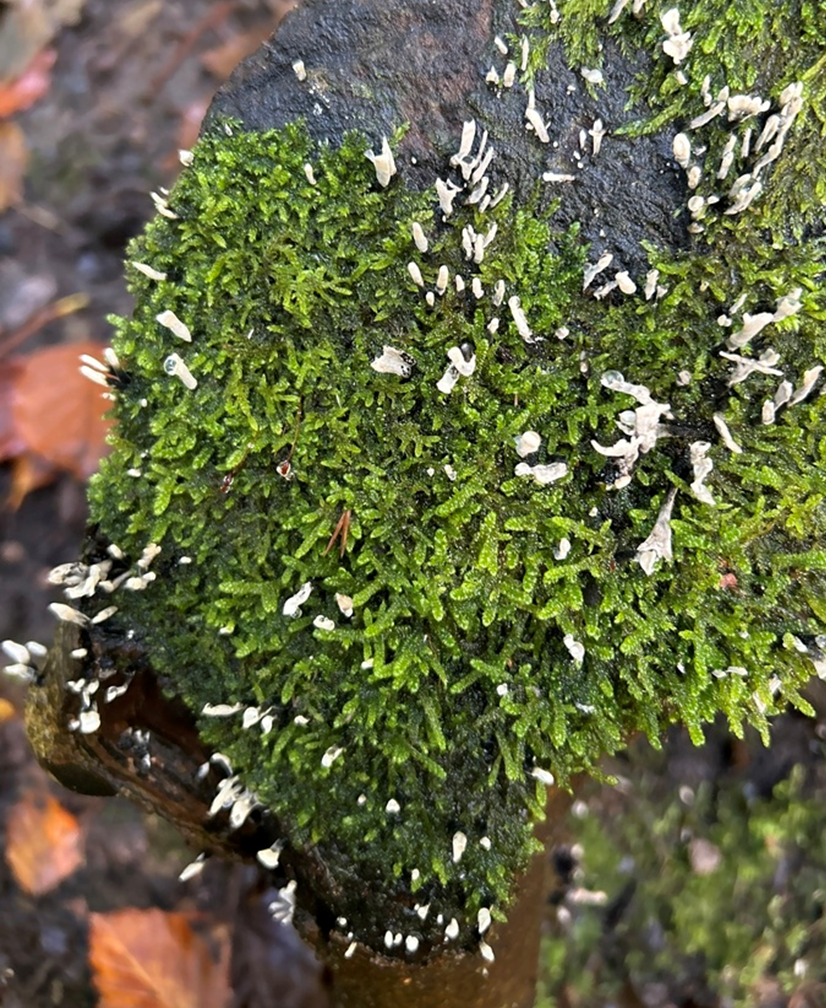
Finally, the smallest of all the fungi featured in this report are Candlesnuff Fungus (Xylaria hypoxylon) pictured below growing amongst lichen. Those shown are only about 1cm tall although they can grow higher, they are also bioluminescent. These were found in Great Wood.
As winter approaches this will probably be the last report of the Wildlife Survey 2024.

 Friends of Astley Park